Espoma Organic
  • Products
    • Close
    • Product Line Overview
    • Plant food finder
    • Garden Fertilizers
    • Potting Soils
    • Lawn Fertilizers
    • Liquid Fertilizers
    • Single Ingredients
    • Conventional Plant Foods
    • Animal Care Products
  • Where to Buy
  • Our Story
    • Close
    • Our Story
    • Locations
    • Historical Timeline
    • Our Commitment
    • Directions
    • Solar
    • Join our Team
    • Espoma Brand Partners
  • Learn
    • Close
    • Espoma Blog
    • FAQ’s
    • Pocket Guide
    • Espoma Guides
    • Garden Clubs
    • Safe Paws Lawn
    • PRODUCT FACT SHEETS
    • Fertilizer Fundamentals
      • Close
      • Understanding Plant Nutrition
      • Reading Labels
      • Choosing the Right Type of Fertilizer
      • Terms & Definitions
    • Gardening Projects
    • Resource Links
  • Contact Us
  • Menu Menu

Tag Archive for: organic plant food

Guide to Growing Organic Tomatoes

May 18, 2015/in Fruits & Vegetables, Spring Gardening, Vegetable Gardening

If there’s one vegetable that needs to be in your organic garden, it’s tomatoes! Juicy, red tomatoes are the taste of summer.

In a salad, drizzled with olive oil, sliced with fresh mozzarella or even eaten like an apple, homegrown tomatoes make every summer meal taste better.

Like all homegrown food, they’re picked when they’re the juiciest and most flavorful. And since you care for tomatoes all season, you appreciate theorganic tomato care and work it takes to ethically raise them. You know without an inkling of doubt that these tomatoes are organic, packed with nutrients and 100% free of harmful pesticides.
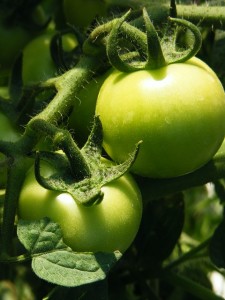
Plus when growing your own tomatoes, you get to pick exactly the kind you want! There are over 10,000 different types of tomatoes, in nearly every size and color.

To pick the tomatoes best for you, decide if you’d like to snack on tomatoes throughout summer. These are known as Indeterminate. Or if you’d like your crop to ripen at once at the end of summer, select determinate.

Also, think about how you’d like to use your tomatoes. Will you use them in lots of fresh recipes or can and preserve and save them for winter? See our favorite tomatoes below to pick the one right for you!

Best Tomatoes to Eat All Summer (Indeterminate)

  • Best Tomatoes for Sandwiches: Brandywine– The original scrumptious beefsteak, and all other beefsteaks
  • Best Tomatoes for Early Harvest: Early Girl– Bright red in color and flavor
  • Best Tomatoes for Sun-Drying: Any Cherry tomatoes

Best Tomatoes for Canning and Sauces (Determinate)

  • Best Tomatoes for Sauces – Full-flavored Roma
  • Best Tomatoes for Canning –Viva Italia which are virtually seedless
  • Best Overall Tomatoes: Rutgers– Abundant, uniform tomatoes that are perfectly tasty
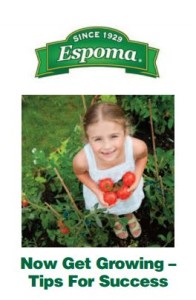
tomato successPick one (or a couple) tomato varieties and get planting! Follow along below or check out how not to be a couch tomato with these tips.

Since tomatoes love the sun, they need a spot that gets at least 6 hours of sunlight a day.

Then, boost your soil. Mix in 3” of homemade compost or organic Garden Soil into the top 6” of your soil.

While you’re at it, mix in 9 cups of Espoma’s Tomato-tone per 50 square feet. For single plants, use 3 tablespoons of Tomato-tone per plant.

An organic plant food like Tomato-tone provides tomatoes the nutrients they need to grow big and plump. Since this is a slow-release, organic fertilizer, Tomato-tone never forces rapid growth, which reduces tomato yield.

Now dig a hole larger than the tomatoes’ original container. Look at the plant tag to see how far apart each tomato plant should be.

Situate the plant in the hole so its lowest leaves are below the soil level. Go ahead and pinch those lower leaves off.

Then fill the hole with amended soil or Espoma’s Organic Garden Soil.

To set your tomatoes up for success, stake them now to increase air circulation and sunlight exposure.

You can support them with a tomato cage, trellis or container. Or hammer 6-8” stakes 1’ into the ground about 3-6” away from the plant. When tomatoes begin blooming, tie them to the stake.

Right now though, all they need is some water! For the next few days, water tomatoes generously. Then, give tomatoes about 2” of water around their base each week.

In addition to watering, feed your tomatoes an organic tomato food each month. Organically fertilizing tomatoes with Tomato-tone produces larger, plumper tomatoes all season.

In 3-5 weeks, add 2-3” of mulch to reduce water consumption.

It won’t be long now until you’re biting into the first, fresh tomato of the season!

Share this post if you LOVE growing tomatoes!
https://www.espoma.com/wp-content/uploads/2015/05/tomato-409404_1280.jpg 853 1280 espoma https://www.espoma.com/wp-content/uploads/2023/05/espoma-logo340w-1.png espoma2015-05-18 13:46:512019-05-07 10:08:45Guide to Growing Organic Tomatoes

Grow Fresh Herbs at Your Fingertips

May 14, 2015/in Fruits & Vegetables, Spring Gardening, Vegetable Gardening

Forget dried, stale or store-bought herbs. There’s a cheaper, closer and fresher alternative.

Plant an herb container garden near your kitchen or next to the grill.

Having fresh, organic herbs right where you cook makes them easier to incorporate into any meal.

With just a few snips, fresh herbs will invigorate your cooking. With just one bite, you’ll instantly taste the difference. Plus, you can use fresh herbs in unexpected ways, like flavoring olive oil, tea or water

Whether you garden in a large space or a small apartment, an herb container garden is convenient and delicious!

All you need to cook up your next great dish is a sunny spot, a roomy container, the best organic potting mix and your favorite herbs.

First decide which (and how many) herbs to grow. Check old grocery lists or recipes to see which herbs you buy the most but especially spend the most money on. Choose those and grow some just for fun like relaxing lavender and lemon balm!

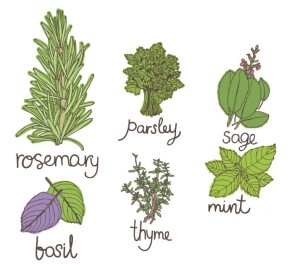
HerbMost herbs will work in a container but the best herbs to plant in containers are: Basil, Mint, Rosemary, Thyme, Oregano, Cilantro, Parsley, Sage, Chives, Lavender, Tarragon, Lemon Verbena
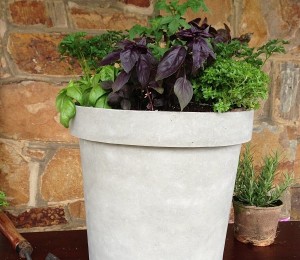
Now pick a container with drainage holes. With container gardens, you can buy a modern or traditional container or get creative and use found objects.

Grouping herbs together that like the same amount of water, light and soil in the same container.

How many herbs you should plant in one container? There’s no hard and fast rule. Use your judgment and read the plant tags.

Go ahead and arrange containers on your deck, patio or any place that’s easy to access when you’re cooking. The area should get between 6-8 hours of sunlight a day.

Once your containers placed, fill half-way with a high-quality, organic potting mix such as Espoma’s Organic Potting Mix. Since you’ll be eating and serving them, organic potting soil is a must!

Now arrange the herbs to your liking! Try 3 or 4 different placements before planting. Read the plant tags to see how big the plants will get, too. And just like those class photos, the tallest go in the back!Container Garden

Once you’re happy with where the herbs are, fill the rest of the container with Espoma’s Organic Potting Mix. For a two gallon container, add 1 cup of Espoma’s Organic Bio-Tone Starter Plus to the top 4-6” of soil. For a five gallon container, add two cups.

Pat the soil to firm and remove air bubbles.

Feeding herbs with an organic fertilizer regularly promotes bigger plants, so you’ll have a bigger harvest. Bio-Tone Starter Plus is a microbe enhanced all natural plant food that will help your herbs to establish quickly.

Give your herb containers 1” of water a week.

Harvest herbs often! The more you pick, the more they’ll grow. Don’t you just love plants like that?

What herbs are you planting this year? Share your favorites by commenting below!

https://www.espoma.com/wp-content/uploads/2015/05/mint-521401_640.jpg 460 640 espoma https://www.espoma.com/wp-content/uploads/2023/05/espoma-logo340w-1.png espoma2015-05-14 08:35:362019-05-07 10:08:45Grow Fresh Herbs at Your Fingertips

Get More Blooms on Roses with a Monthly Organic Feeding

April 21, 2015/in Flowers, Spring Gardening

Imagine growing a rose bush bursting with big, beautiful flowers. It’s easy.

All your roses need is a well-balanced meal. Roses are one of the hungriest plants, so they need to be fed often to perform their best.

You’ll instantly see the difference once you start regularly feeding your roses. Bigger, better and even more roses are on their way! Plus, your plants will look healthier since they’ll fight off disease more efficiently.

It’s amazing how much a healthy, organic meal can improve your roses.

Your roses are waking up now since spring is just beginning. They’ve made it through a long winter and they are starving! Feed them the most nutritious meal you can.

Espoma’s organic Rose-tone includes more nutrients than any other rose food. Most rose fertilizers contain three nutrients — nitrogen, phosphorus and potassium (N-P-K). Rose-tone goes far beyond that. This organic rose food contains 12 more micronutrients roses need, including iron, calcium and magnesium.

Feeding roses with Rose-tone is like providing a perfectly balanced meal. Your roses get all the nutrients they need to work as hard as they can.

Another benefit of organic rose foods, such as Rose-tone, is the gradual release of nutrients. Due to its slow-release formula, Rose-tone will never burn or leach plants. Plus, this is the only organic rose food that improves soil structure.

In beds, spread 6 pounds of per 100 square feet. For individual roses, use 1¼ cups of Rose-tone per plant.

Now, let’s boost your roses and soil with an organic feeding.

For established roses in beds, spread 6 pounds of Rose-tone per 100 square feet. For individual roses, use 1¼ cups of Rose-tone per plant.

Sprinkle the granular organic rose food around each plant out to the widest branch. This encourages your roses to stretch their feet and grow a little!

Then, scratch the food into the top 1” of soil.

If you’re planting new roses, add a mixture of peat moss and 3 cups Rose-tone to the planting hole.

Either way, feed your roses monthly from early spring to mid-September to keep them producing beautiful blooms.

Feeding roses with organic plant food is one of the best ways to get bigger, healthier roses. Share another trick to keep roses booming below.

https://www.espoma.com/wp-content/uploads/2015/04/roses-espoma2.jpg 872 873 espoma https://www.espoma.com/wp-content/uploads/2023/05/espoma-logo340w-1.png espoma2015-04-21 11:01:542019-05-07 10:09:24Get More Blooms on Roses with a Monthly Organic Feeding

The Secret to Growing Bigger Plants, Faster

March 31, 2015/in Vegetable Gardening

Drum roll please! The start of planting season is here!

After long weeks spent pouring over seed catalogs and admiring Pinterest gardens, it’s time to finally create the garden of your dreams.

If you started seeds a few weeks ago, it’s time to gradually move them outside. And if you didn’t, a trip to your local garden center awaits you.

So now that you’re ready, let’s plant your soon-to-be flourishing garden.

How to know if your garden is ready for planting:

To see if the ground is thawed and warm enough for planting, dig 3-4” deep. Grab a handful of soil and roll into a ball. If the soil won’t take shape, it’s too hard and dry for new plants.

If you can make a ball, drop it to the ground. If it breaks, your soil is ready. If the ball stays together, your soil is too wet, so try again in a few days.

Now comes the fun part, deciding what to plant!

Roses, snapdragons and pansies are some of our favorite flowers to plant in early spring. Plus, they add a pop of color when you need it most.

As far as veggies go; plant peas, spinach, kale, lettuce, broccoli, carrots and onions in early spring. Imagine how much you’ll save on groceries in the upcoming months!

Before you buy your new plants, check the plant tags to make sure you have enough space and sun.

Now time to plant:

If planting a flower bed, mix 4 lbs. (12 cups) of Bio-tone Starter Plus, an organic plant food, per 100 square feet into the top 4-6” of soil.

Adding all-natural, organic plant food enhanced with bacteria is the secret to bigger, better plants of all kinds.

Bio-tone Starter Plus is like a protein shake for your plants. This organic plant food is jam-packed with microbes and mycorrhizae to provide an instant health boost.

Seriously, the proof is in the plants.

Bio tone Starter Plus gives plants everything they need to grow bigger blooms faster. So, you’ll lose fewer plants along the way. You can also add Bio tone when planting bulbs, container gardens, shrubs and even trees. Using this organic plant food on veggies and fruits is a-ok since it’s all natural.

Now, get digging! You can plant in individual holes or a garden bed. Either way, dig holes as deep as the containers the plants came in, and check the plant tag to see how far apart to plant.

Remove plants from containers; loosen roots and pop ‘em in the hole!

Then, replace the soil around the plants and water.

Finally, add the finishing touch of 2-3” mulch — if you haven’t already.

What are you planting this spring? Comment below or better yet, share a picture on our Facebook page!

https://www.espoma.com/wp-content/uploads/2015/03/3847323170_08bf293f0e_b.jpg 683 1024 espoma https://www.espoma.com/wp-content/uploads/2023/05/espoma-logo340w-1.png espoma2015-03-31 10:21:212019-05-07 10:09:24The Secret to Growing Bigger Plants, Faster
Page 23 of 23«‹212223
Where to Buy

Get News & Updates

Recent Posts

  • VIDEO: A Formal Garden Tour with Summer Rayne Oakes
  • VIDEO: Repotting in the Greenhouse with Garden Answer
  • VIDEO: How to Winterize Your Chicken Coop with Summer Rayne Oakes
  • VIDEO: Planting Spring Bulbs in Containers 🪴🌷 with Summer Rayne Oakes
  • VIDEO: Planting the Last Bulbs of the Season with Garden Answer

Tags

All-Purpose Potting Mix bio-tone Bio-tone Starter Bio-tone Starter Plus Cactus Mix caring for houseplants Container Gardening DIY project Espoma espoma grown espoma organic Espoma Organics Espoma Video fall gardening Family fert flower garden flowers garden Garden Answer Gardening gardening tips gardens grow holly-tone houseplants Indoor! indoor gardening indoor plants Kaleb Wyse organic organic fertilizer Organic Gardening organic plant food Organic Potting Mix Outdoor Gardening Planting plants Potting Mix potting soil Spring Gardening summer rayne oakes vegetable garden Vegetable Gardening Wyse Guide

Espoma. A Family Tradition Since 1929.

Espoma Organic logo
  • Espoma Dealer
  • Espoma Pro
  • Garden Club
  • Privacy Policy

Scroll to top